我們的服務
寵物護理服務
獸醫服務
其他
Length range : 36-43 cm
Height range : 23-28cm
Weight range : 3.2-8.2kg
Coat : Semi-long|single coat|soft cashmere-like texture|no undercoat|seasonal coat variation|water resistant or waterproof feel
Life expectancy years : 12-18
Colors: white with Van pattern on head and tail|red and white|cream and white|black and white|blue and white|tabby and white|parti-color and white|pure white.
Activitity Level : High
Origin: Turkey
Similar Breeds : Turkish Angora
The breed developed in the Lake Van region and broader central and southwest Asia , including Turkey. Modern breed history describes British photographers bringing a pair to England in 1955 and later imports helping establish the breed in Europe and the United States. CFA notes recognition in 1988 and championship status in 1994 while other text notes championship status in 1979 through TICA.
Playful
Loyal|loving|affectionate|intelligent|active|playful|fun-loving|mischievous|social|energetic|companionable|vocal
Needs regular exercise , interactive toys , climbing areas , high vantage points , space and attention. Because of strong activity and intelligence , enrichment and supervised safe outdoor or indoor play may be helpful.
Social and loyal with owners , often good with dogs if introduced properly , but may do best with older children and homes that understand they dislike prolonged holding or rough handling. Some sources say they may not get on well with very young children.
The coat is easier to care for than it looks because there is no undercoat and matting is uncommon. Weekly combing is often enough , though the heavier winter coat may need more frequent attention. Routine nail trimming , tooth brushing , ear care and general hygiene are advised.
Good-quality wet or dry food and fresh clean water are recommended. Portion control matters because the breed can become overweight if under-exercised. Some guidance suggests keeping water away from food and using fountains to encourage drinking.
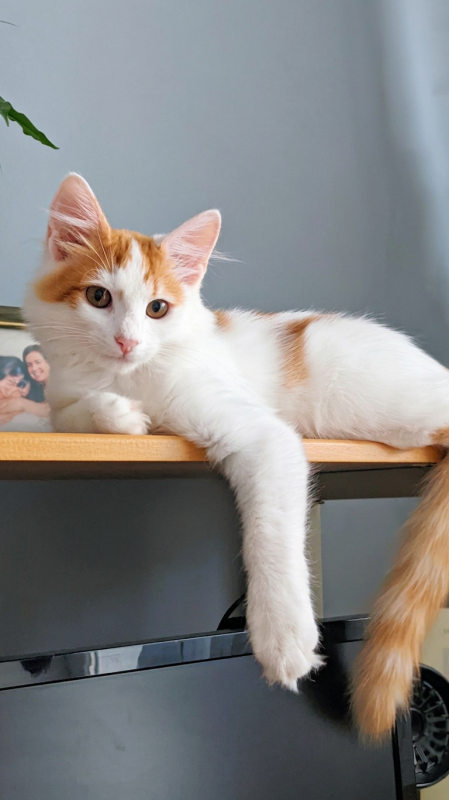
The Turkish Van is a natural semi-longhaired cat from a rugged region with a substantial , broad , muscular body and a distinctive Van pattern. Adults should appear balanced and well proportioned with no undercoat , strong chest and legs , and maturity reached at 3 to 5 years.
The Turkish Van is often called the swimming cat and may voluntarily play with water or swim. Some cats have a small neck or shoulder marking called the thumbprint of Allah or thumbprint of God and the breed can continue growing until about five years of age.
Congenital sensorineural deafness, Obesity and related complications, Feline dental disease, Hypertrophic cardiomyopathy, Kidney disease
1. Complete unresponsiveness to sound , very loud meow , easy startling when touched and heavy sleeping may occur.
1. Loss of waist , inability to feel ribs , belly fat pad , reduced activity and difficulty grooming may occur.
1. Bad breath , red inflamed or bleeding gums , visible tartar , drooling , pawing at the mouth and eating changes may occur.
2. Excess salivation , blood in saliva , loose teeth , pain on mastication , weight loss and poor grooming might occur.
1. Heart murmur or gallop rhythm , increased resting respiratory rate , lethargy and open-mouth breathing may occur.
2. Sudden hind-limb paralysis might occur in severe cases.
1. Increased thirst , increased urination , weight loss , poor appetite , nausea , vomiting , lethargy , poor coat and chemical-smelling breath may occur.
1. Present from birth.
2. It may be noticed around 3 to 4 weeks.
1. Risk may be high only in specific cats.
2. All-white Vans with two blue eyes may have 60-80% probability , odd-eyed white Vans 30-40% , all-white Vans with amber or green eyes 10-20% , while traditionally patterned Vans may have much lower risk.
1. Can begin around 1 to 2 years after maturity slows and after spay or neuter.
1. Probability may be very high without portion control and enrichment.
1. Mild gingivitis may begin at 1 to 2 years.
2. Significant disease is common by 4 to 6 years and many cats over 3 years may need intervention.
1. Probability may be very high and over 85% of cats over age three may have some form of dental disease.
1. Usually diagnosed in adults from 2 to 8 years.
1. Risk may be low to moderate.
1. Signs usually become apparent in senior cats after about 7 to 10 years.
1. Probability may be high in senior cats because many domestic cats develop some degree of disease with age.
1. No chemical deficiency is indicated because this is genetic.

1. No chemical deficiency is indicated because plaque , tartar and bacterial inflammation are emphasized.

1. No deficiency is indicated because this is linked to excess calories though chronic inflammation may occur.

1. No daily lack is indicated though taurine is noted as essential for feline heart health.

+852 6358 3131
香港中環德輔道中84-86號章記大廈9樓01室
週一到週日,早上10點到下午9點
 +852 9160 8619
 +852 9160 8619