我們的服務
寵物護理服務
獸醫服務
其他
Length range : 38-46 cm
Height range : 20-25cm
Weight range : 4.5-5.4kg
Coat : Long to semi-long / silky / single / easy-care coat with point coloration and white gloves and laces. The coat is light on the body with darker points and may show a golden mist.
Life expectancy years : 13-15 (depends on health situation)
Colors: seal point|blue point|chocolate point|lilac point|red point|cream point|seal tabby point|blue tabby point|chocolate tabby point|lilac tabby point|tortie point|cream tabby point|all pointed colors.
Activitity Level : Moderate
Origin: Myanmar
Similar Breeds : Ragdoll
The Birman is associated with Burma in legend and historical accounts say a breeding pair was shipped from Burma to France around 1919 where the foundation female arrived pregnant. The breed was shown in France in the 1920s / recognized in England in 1966 / arrived in the United States in 1959 to 1960s / and was accepted for CFA registration in 1967. After World War II the breed was rebuilt in Europe with outcrossing to Persians and Siamese before pure Birman litters reappeared by the early 1950s.
Playful
gentle, affectionate, sweet, loving, loyal, faithful, quiet, soft-spoken, sociable, people-oriented, patient, even-tempered, tolerant, playful, intelligent, helpful, friendly, companionable
Needs companionship / gentle play / regular interaction / and a home that keeps the cat in good condition with moderate activity and close human involvement.
Very social and people-oriented. Birmans enjoy attention / do well with families / children / seniors / and other pets / and may not do well alone for long periods so a companion may help.
Birmans are relatively easy to groom because the silky coat has no heavy undercoat and tends not to mat. Weekly combing is usually enough though more frequent grooming may help during seasonal shedding. Nails / ears / and teeth should also be maintained regularly.
A good-quality balanced diet and fresh clean water are appropriate. Portions and treats should be managed in moderation and diet may be adjusted if kidney disease or dental issues develop. Wet food and multiple water sources may help hydration in older cats.
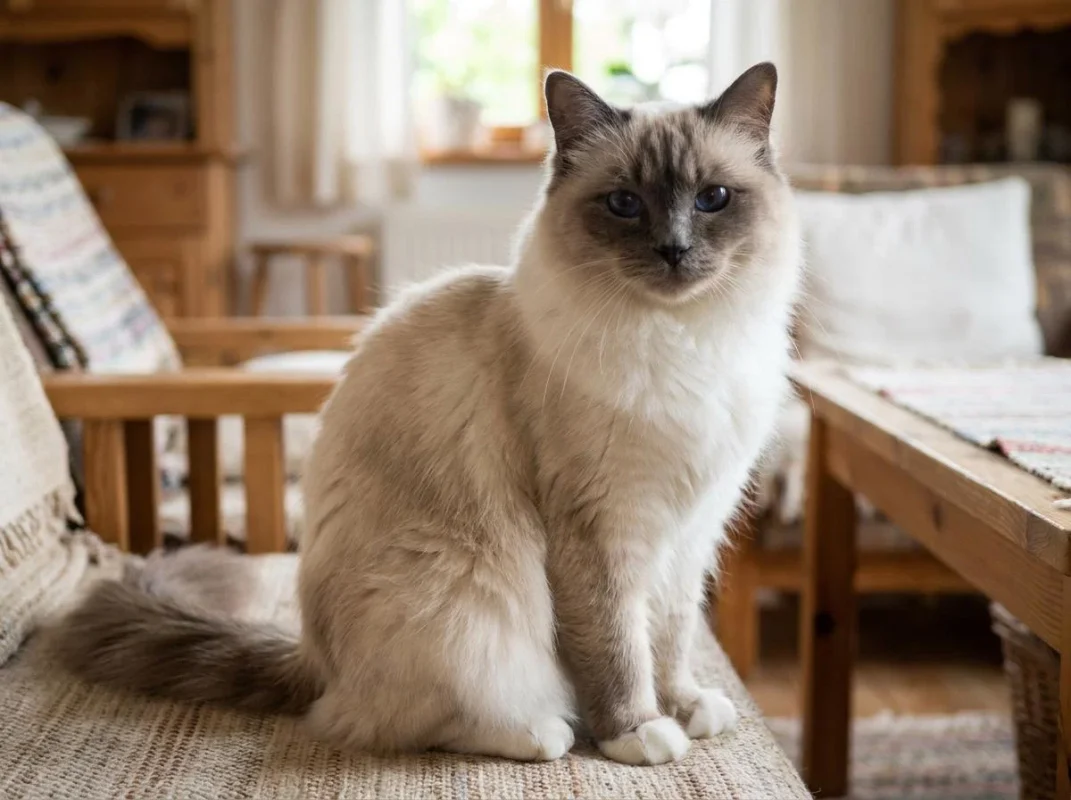
The Birman standard describes a strongly built / elongated / stocky color-pointed cat with long silky hair / four pure white feet / blue almost round eyes / medium Roman nose / medium ears / heavy boning / and symmetrical gloves and laces.
Birmans were nearly lost in Europe after World War II and were rebuilt by breeders. The breed is famous for its Roman nose , blue eyes , white gloves , and Sacred Cat of Burma legend.
Hypertrophic cardiomyopathy, Chronic kidney disease, Birman congenital hypomyelination, Feline cataracts, Dental disease
1. May show no early signs 2. Heart murmur or gallop rhythm may be found 3. Increased resting breathing rate / open-mouth breathing / lethargy / decreased appetite / sudden hind leg paralysis and pain may occur
1. Early signs may include increased thirst and increased urination 2. Weight loss / poor appetite / vomiting / lethargy / dull coat may appear 3. Pale gums / vision changes / weakness may occur with anemia or hypertension
1. Severe whole-body tremors 2. Wobbly or uncoordinated gait 3. Trouble standing or walking properly
1. Cloudy bluish-gray or white pupil appearance 2. Vision impairment / bumping into objects / trouble in dim light 3. Complications may include glaucoma-related pain
1. Bad breath 2. Red swollen or bleeding gums / visible tartar 3. Drooling / dropping food / pawing at mouth / facial swelling
1. Screening may detect changes from about 1 year
2. Clinical signs often appear in adults from about 2 to 8 years
1. Moderate
2. Risk may be lower when breeders perform regular echocardiographic screening
1. Usually affects older cats
2. Signs often become noticeable at 7 years or older though earlier diagnosis may occur
1. High in senior cats
2. Age is the main known risk factor and the content suggests possible breed predisposition
1. Present at birth or within the first weeks of life
1. Very low
2. DNA testing may have made this uncommon in tested lines
1. Hereditary forms may appear from about 1 year
2. Senile cataracts may appear in senior cats
1. Low to moderate
2. Risk may be higher than general population because of predisposition
1. Mild gingivitis may begin by about 1 year
2. Many cats show dental disease by age 3
1. Very high
2. The content suggests most cats may develop some degree without prevention

1. Usually genetic rather than caused by deficiency
2. Taurine lack is mentioned only as a cause of a different similar-looking heart disease

1. Genetic failure of myelin production rather than a dietary lack

1. Usually linked to genetics / age / or underlying disease rather than daily deficiency
1. Hydration may be lacking because dehydration is a major concern
2. Potassium may become low
3. Water-soluble vitamins may be lost in urine

1. Lack of mechanical abrasion from teeth-cleaning action may contribute to plaque buildup

+852 6358 3131
香港中環德輔道中84-86號章記大廈9樓01室
週一到週日,早上10點到下午9點
 +852 9160 8619
 +852 9160 8619